
Object Record
Images
Metadata
Object Name |
Embroidery |
Caption |
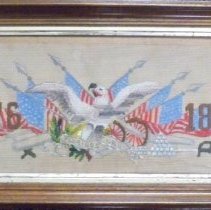
Framed embroidery |
Description |
Framed embroidery on perforated paper done by Edith Pendergast with materials purchased by her in Philadelphia. Embroidered during the 1776-1876 US Centennial this antique, Folk Art Embroidery depicts an American Eagle, eight flags and motto "E Pluribus Unum". It was left unfinished at her death in 1878. Set in wood frame with glass. Edith Pendergast was the daughter of W. W. Pendergast. Edith was born in Minnesota c.1860. Sophie Pendergast White was her youngest sister, born February 5, 1873. The Centennial International Exhibition of 1876, the first official World's Fair in the United States, was held in Philadelphia, Pennsylvania, from May 10 to November 10, 1876, to celebrate the 100th anniversary of the signing of the Declaration of Independence in Philadelphia. Officially named the International Exhibition of Arts, Manufactures and Products of the Soil and Mine, it was held in Fairmount Park along the Schuylkill River on fairgrounds designed by Herman J. Schwarzmann. Nearly 10 million visitors attended the exhibition and thirty-seven countries participated in it. [Wikipedia] Perforated paper: Perforated paper was called Bristol Board and was punched cardboard with even rows. It was heavily stitched in the 1820 to 1900 range peaking in the 1870s. It was mostly stitched with religious or moralistic sayings, sometimes with Home Sweet Home. It was a counted thread technique. Some were bookmarks, some framed pictures. It is quite rare to find old ones and they can be very expensive to purchase. Holes can be 28 mesh per inch to 10 mesh per inch. The stitches used were the tent stitch and the cross stitch, but the satin stitch was used more and more as the century progressed. At first Bristol board was used mainly for bookmarks and pictures, but with the Victorian mania for making trivia it was soon put to use for stamp houses, letter holders, dust cloth holders, waste baskets, card baskets, needle cases, cigar cases and work boxes. Bristol board was worked in cotton thread and wool generally, but occasionally in silk and chenille and even in beads. Mottos were an integral part of Victorian life and were intended to inspire the reader and promote "proper" thoughts and behavior. Many were used for mourning purposes, some for fraternal groups and to celebrate the 1876 American Centennial. They were moral reminders, hung up for the season or to greet friends upon arrival. With the popularity of the product mottos and bookmarks were pre-printed on the perforated paper. Mottos were framed in a rustic frame and sometimes backed with tinsel foil or colored paper. Wooden backing board leached oils into the paper and left stains. Perforated paper is available today and mostly used for counted cross stitch for book markers or small pictures. Sometimes beading is done but the paper is heavy for that use. (2017 Research on perforated paper by Carolyn Ulrich). |
Catalog Number |
1979-0246-001 |
Search Terms |
Needlework Embroidery Centennial celebrations Pendergast Family |
Subjects |
Needlework Embroidery Centennial celebrations |
People |
Pendergast, Edith |