
Object Record
Images
Metadata
Object Name |
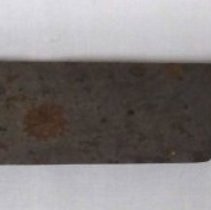
Knife |
Caption |
Table knife |
Description |
Table knife riveted to wooden handle. Manufactured by J. Russell, Green River Works. Matches knife 1979-0555-001 and forks 1979-0564-001 & 1979-0566-001. John Russell was born March 30, 1797 in Greenfield, Massachusetts. At the age of 21, Russell left Greenfield for Georgia, where he speculated in cotton and became successful. In 1830 he left the business and married Julianna Witmer of Lancaster Pennsylvania, where he lived for the next two years. Then in 1832 Russell made a visit to see family and friends back in Greenfield and was persuaded to return. Rather than enter an established industry or business, Russell choose the manufacturing of cutlery. At age 35, he had no prior experience or background in cutlery manufacturing. His business was called J. Russell & Co. Sheffield, England was then a center for cutlery making which set the standard of quality against which other cutlery making centers, such as Solingen, Germany, were judged. Late in 1833, Russell completed a factory and chose to start with chisels and axes. Using only the finest English steels available as raw material, his products quickly earned a local reputation for quality. By September 1834 Russell felt that he had the experience to begin manufacturing of simple butcher and carving knives, made from the finest raw materials available. As knife manufacturing increased in importance, Russell would gradually phase out chisels and axes. The early knives were stamped "J.Russell & Co American Cutlery." Although these knives had a local reputation for quality, most Americans of the time preferred knives from Sheffield. Russell's factory expanded in size, number of machines, and an additional new steam engine. By February 1836 Russell purchased land and moved the factory to a location on the Green River (Massachusetts). The new location came complete with buildings, a dam and was set up for utilizing water power. On March 15, 1836 a fire burned out the forging shop and production was halted. Reconstruction had hardly begun when a major flood swept away the dam and most of the buildings. After the flood, Russell was left with little besides the land and a few machines that had been salvaged. With the financial assistance of Henry Clapp, Russell rebuilt the factory, dam and bridge that had been at that location. The new factory had one building which housed the forging room with trip hammers. Another building housed grindstones and emery wheels. A third building contained hardening and tempering apparatus, with the hafting department in it's upper level. The new factory was christened the "Green River Works" and knives produced here were stamped "J.Russell & Co. Green River Works." It wasn't until the "Green River Knife" hunting knife was designed and produced that quality of domestically produced cutlery was overwhelmingly accepted by American consumer. The Green River Knife became a favorite of emigrants, buffalo hunters, Indians, miners and settlers. With the success of the Green River hunting knife, Russell began to experiment with other new types of knives for skinning and butchering. Russell continued to expand his product line to include shoe knives, table knives and forks and occasional novelty knives including a knife designed for one armed amputees after the Civil War. |
Catalog Number |
1979-0557-001 |
Search Terms |
Knives Tableware |
Subjects |
Knives Tableware |