
Object Record
Images
Metadata
Object Name |
Drum |
Caption |
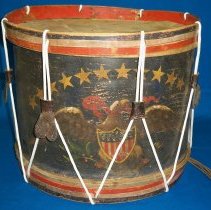
Civil War drum |
Description |
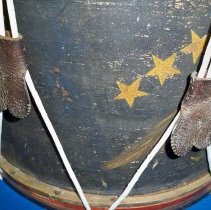
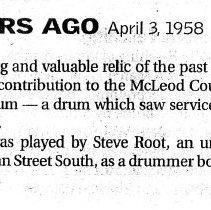
Civil War era drum with a painted emblem on blue showing an eagle & 13 arched stars above a patriotic 13 stripe shield. The eagle holds an olive branch (peace) and four arrows (military preparedness or war) in its talons and is facing toward the arrows. It holds an "E Pluribus Unum" ribbon in its beak. Red, white & blue stripes trim the top & bottom hoops of the drum. Ropes are strung from top to bottom to hold it together; heart shaped leather ears for adjusting tension are centered on the ropes. Batter and snare heads are of calf or sheep skin and have cat-gut snares held by a snare butt. Written in pencil on the inside of drum: "S. W. Carpenter, Co. D. 10th Minnesota Infantry". Belonged to Wilber Root's uncle Steve (Carpenter) Root, brother of Wilber's father John C. Root. Wilber Root lived at 445 Hassan St S, Hutchinson, MN. Stephen W. Carpenter was born c.1836, son of Malon Carpenter and Mariah Clinton. Mariah later married John L. Root who may have adopted her Carpenter children. In the 1860 census Stephen Carpenter lived next to John L. and Mariah Root. On April 29, 1861 he enlisted in Company G, Minnesota 1st Regiment for three months. On July 5, 1861 he mustered into 2nd Minnesota Infantry and was discharged June 10, 1862 at Louisville, KY with left leg disability suffered at Shiloh TN. On January 21, 1863 Stephen enlisted in Company D, Minnesota 10th Infantry Regiment with rank of Musician. He mustered out on August 19, 1865 at Fort Snelling with a scalp wound suffered in 1864 at Nashville TN. He was admitted to a National Home for Disabled Volunteer Soldiers on August 14, 1903 and was discharged September 14, 1911 at his own request. The 1910 Census listed him as a resident of the Pacific Branch, National Home for Disabled Volunteer Soldiers, Malibu Township, California. ****** By the time of the Civil War the minimum age for an enlisted man was eighteen years. However, a musician could be enlisted as young as twelve years old. Able-bodied men were desperately needed in the front lines, so the position of drummer was often filled by slight young men or very young boys, some as young as eight years old. Civil War drummer boys were an integral part of the war machine. The role of a Civil War drummer boy went far beyond a ceremonial accoutrement, as they were responsible for troop movement. "Drum Calls" were a means of communicating the commands of officers to their men. "Three Camps" was reveille, "Tattoo" meant bedtime, "Commence Firing," "Quick Step," "Advance" and "Retreat" were all part of the repertoire of the well-trained drummer boy. Drummer boys controlled virtually every daily activity of the infantry soldier. It was the drumbeat that told the soldiers how and when to maneuver as smoke poured over the battlefield. Small boys carrying huge field drums could be heard above the roar of a battle. The sight of a drummer boy also provided a visual location for a soldiers’ unit, helping to keep them close together. This placed drummer boys at high risk. The enemy knew that if he took out the drummer boy, the commanders lost contact with their troops. Supply met demand, as over 32,000 regulation drums were manufactured from 1861 to 1865 for the Union Army alone. Drums were made primarily in the important industrialized centers of the Northeast: Boston, New York and Philadelphia. Though there were no governmental standards for drum construction, snare drums were generally 15" to 16" in diameter and 10" to 12" deep. Shells were made of ash, maple, white holly, or similar types of pliable wood. Shells were strengthened with reinforcement rings at the top and bottom. However, glue not being what it is today, the lap or seam of the shell required nails. The nail pattern was sometimes very elaborate, utilizing circles, triangles, diamonds, and/or vertical and horizontal lines. Often a manufacturer could be identified by a particular nail pattern, though a company’s paper label was usually placed inside the shell, opposite the air vent hole. Calfskin or sheepskin heads were tensioned by rope, laced either through holes in the wood hoops or through cast hooks clasped over the hoops. Tension was applied by sliding the tugs or braces down. Snares were usually made of catgut, though rawhide was sometimes used. The crowning glory of many of these drums was their handpainted decorations. Normally the drummer boy would receive his drum with the painting on the shell of the drum. Again, although there were no standards, a blue background was designated for an infantry unit, while a red background signified artillery. An American bald eagle most commonly emblazoned the Federal Army drums but sometimes the Confederates used it as well. Federal drums were also decorated with 13 stars for each of their 13 states. Confederate states were represented with 11 stars. |
Catalog Number |
1988-1488-001 |
Search Terms |
Civil War Military-U. S. Civil War Drums |
Subjects |
Drums American Civil War |
People |
Root, Wilbur Root, Steve Carpenter, S. W. |