
Object Record
Images
Additional Images [2]
Metadata
Object Name |
Accordion |
Caption |
Button Accordion |
Description |
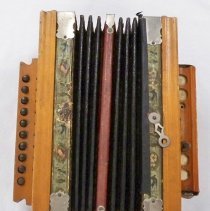
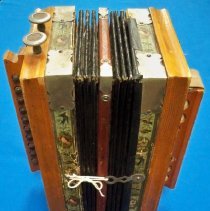
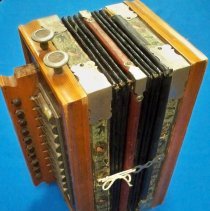
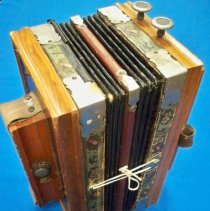
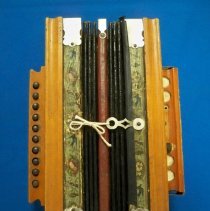
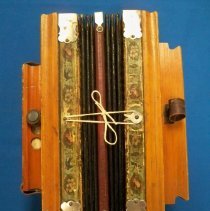
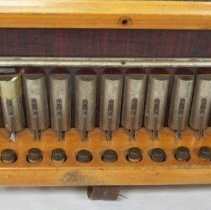
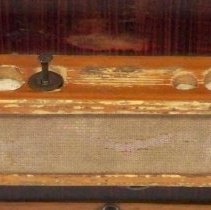
Early button accordion with a one row, ten key treble side, a two button bass side and a single air valve button for expanding or contracting the bellows without sounding a note. Has two pull-out stops on top, decorative birds & flowers and metal corners on the wooden casing, metal clasps, twill hand strap and leather thumb strap. The bellows are made of black & gold patterned cardboard. Possibly German or Polish origin. This instrument is diatonic (single scale) with a single-action (bisonoric) keyboard, i.e. each button produces two notes: one when the bellows are pressed or pushed (closed) and another when the bellows are drawn or pulled (opened). Each button produces a different note on the push and the draw of the bellows. In this respect it operates like a harmonica. The treble casing, the boxy part of the accordion attached to the buttons, contains the reed block. The bass side, opposite side of the bellows from the button side, also uses reed blocks operated by a set of rods and levers. Generally a player can see the buttons on the treble side of the instrument but can't see the bass buttons on the bass side. Because of this, the bass side gives the player a tactile clue with an indented crosshatch pattern (as found on this instrument) or some other identifying bump such as a rhinestone. The life of the accordion is the bellows - the "lung" of the instrument that makes air flow through the reeds. Air is moved through the reed blocks by the action of the bellows, which is the middle part of the accordion that can expand and contract to push and pull air through the reeds. When the bellows are stretched or contracted, the reeds make sound. To move bellows without making sounds from the reeds, one uses a "air button" on the side of the instrument. Bellowing action controlls dynamics and articulation: quick, forceful bellowing produces loud sounds, slow gentle bellowing makes soft sounds. It is believed that the accordion was invented by Friedrich Buschmann in 1822 in Berlin. He called his invention the Hand-aeoline. However, the first instrument patented under the name "Accordion" is credited to Cyrill Demian, a musician from Vienna, in 1829. Demian's accordion was a diatonic button accordion, designed to be played with the left hand. The accordion was an ideal instrument for the mass migrations of the 19th century - the instrument was portable, loud, and relatively easy to play. It also worked as a "one-man band" playing melody and harmony at once. As people left Europe to the New World they brought their accordions with them. Accordions were often heard in folk music and ethnic music, particularly in German and Polish ethnic music. |
Catalog Number |
1979-0118-001 |
Search Terms |
Accordions |
Subjects |
Accordions |