
Object Record
Images
Metadata
Object Name |
Hornbook |
Caption |
Hornbook |
Description |
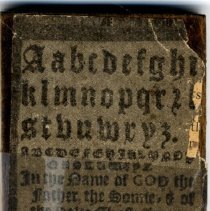
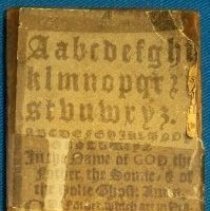
Replica of a child's hornbook used to teach the alphabet. Paper with the alphabet and the Lord's Prayer is taped to wood shaped like a hornbook. [The J and V are missing from the alphabet. Due to the influence of Latin, the letters J and I were once considered interchangable, as were the letters U and V.] A Hornbook looks very similar to a paddle and was fashioned from horn and wood, hence it's name. It was used as a simple primer to teach children the alphabet, numbers and of course the Lord's Prayer. Hornbooks consisted of a piece of parchment paper lesson that was pasted onto a wooden paddle . Cut sheets were made out of goat or sheep horn that were boiled in water and then pressed and attached to the board by using a brass or latten border with minute tacks. After the cut sheet was mounted on the frame it was protected by yet another thin transparent sheet of cow's horn. These hornbooks were worn as part of the child's wardrobe either around the neck or waist as a hole was present at the top of the handle. Paper was scarce and expensive during colonial days. A student’s first lesson, the ABCs, was written on a piece of parchment. The parchment was laid on a flat wooden board with a handle. To protect the parchment on the board, a flattened cow’s horn was placed over it. To flatten the material, the cow horn was first stored in cold water for several weeks, separating the horn from the bone. Then the horn was heated, first in boiling water, then by fire, and pressed by plates and machines to make it smooth and transparent. The thin, translucent horn was then fastened onto the parchment, protecting the lesson from its daily use. Each hornbook handle had a hole so a rope could be fastened to it and the hornbooks worn around the neck or fastened to a belt. Thus, hornbooks would not be lost on the way to school and were easily accessible. The earliest records of hornbooks are noted in 1442. In the 1500's the hornbook became standard equipment in English schools. As English settlers sailed to America's colonies, their hornbooks came with them. As time went on, hornbooks were also made of a variety of other materials besides wood. Ivory, various metals, leather hornbooks ranged from plain, whittled types, to elaborately carved hornbooks. Hornbooks were used only in England and America until their decline in the early 1800s. As paper became more available to common folk, hornbooks became obsolete, kept as historical artifacts and to relive warm school memories. Today, authentic hornbooks may only be viewed at museums or private collections. |
Catalog Number |
2013-0001-099 |
Search Terms |
Hornbooks Alphabets (Writing systems) |
Subjects |
Alphabets (Writing systems) Hornbooks |