
Object Record
Images
Metadata
Object Name |
Lantern, Railroad |
Caption |
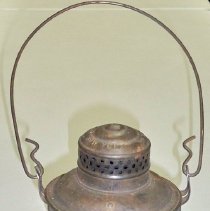
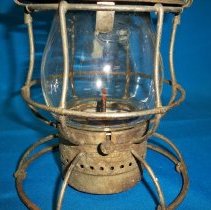
Kerosene railroad lantern |
Description |
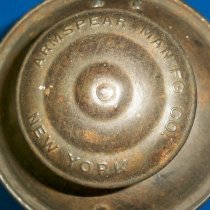
Railroad lantern made by Armspear Manufacturing Company, New York. Clear glass tall Vulcan globe by Dietz, New York; lift-up cover with snap closure; unreadable dates on burner; no railroad designation. Belonged to donor's father Axel M. Jensen. It was manufactured before 1920, at which time the height of the globe changed to short, and it was the type used during World War I. In the days before city lights and GPS, railroad lanterns served a very important purpose: they communicated signals at night between trains and stations. Sometimes, a timely lantern signal meant the difference between life and death. Railroad lanterns were used by the workers of the rails to communicate with each other as they went about their daily pursuit of running the railroad line. Back in the time of steam locomotives communication was vital for running the trains effectively. Distance and noise in the train yards and along the rails made this very difficult. Radio devices were not available during this period so they had to come up with a system to signal each other. Kerosene lanterns became the most effective communication system at night. Railroad lanterns were an efficient and portable light source that could be seen over long distances. Many rail workers continued to use the lanterns even after more modern methods came on the scene. For example the flashlight did not give as strong a signal and required the constant changing of batteries. The lanterns could even be used as a source of warmth on cold nights. In the most basic sense, railroad lanterns have four components: a base, a wire guard (or cage), a chimney, and a glass globe housing the light source. The cage protects this globe from damage. These lanterns are organized into five basic categories. The first is called an Inspector lantern and was typically made of sheet metal that had a reflecting surface of glass or metal to focus light in one direction. The flame was contained within a globe like structure. Fixed globe lanterns were some of the first railroad lanterns made during the Civil War and had the globe inside that was not removable, thus requiring different lanterns for different signals. The next was referred to as a tall globe lantern that had the distinction of having removable globes. The ability to interchange globes made it possible to alter colors and send a different type of signal. During World War I this became the most prominent style of lantern used on the rails. Globes (the glass part of the lantern) were obtained in five colors; clear, red, yellow, green, and blue. Clear was used for hand signals and for general illumination. Red was used to stop trains and for other purposes. Yellow was used for a variety of purposes as specified in the rule book. Green was used to indicate that it was clear for trains to proceed. Blue was used to mark equipment which should not be moved. After World War I until the 1960s, the tall-globe lantern gave way to the short-globe lantern. Short-globe lanterns had a globe that was no more than 4 inches in height. This smaller chamber size was better suited to burn kerosene, which had replaced signal oil as the main lantern fuel. It was also more portable than earlier models. The fixed-, tall-, and short-globe lanterns are known as trainmen’s lanterns since they were used by various crew members on a train. The final lantern is referred to as a Presentation lantern or Conductor's lantern. These lanterns were mostly used as rewards for recognition and were commonly engraved. They were still useful for work purposes but were more delicate because they had brass or nickel plating on the outside. |
Catalog Number |
2014-0045-001 |
Search Terms |
Lanterns Railroad lanterns |
Subjects |
Lanterns |