
Object Record
Images

Metadata
Object Name |
Lantern, Railroad |
Caption |
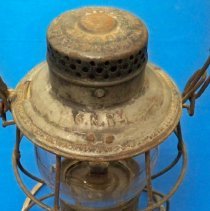
Railroad lantern |
Description |
Adlak "Reliable" railroad lantern marked "G.N.RY." for Great Northern Railway. Made by Adams & Westlake, New York, Chicago, Philadelphia. Clear glass removable short globe marked "G.N.RY Safety Always"; lift-up cover with snap closure. The most popular and common of the lantern models, Adams & Westlake's Reliable lantern was manufactured from around 1912 to sometime in the mid 1920's. Adams & Westlake was one of the best known and oldest manufacturers of railroad lanterns. Otherwise known as Adlake, the company was reported to have been founded in 1857. However, it wasn’t until 1874 that J. McGregor Adams and William Westlake merged their interests and provided the lasting name for the company. The first namesake, J. (John) McGregor Adams, was born in Londonberry, NH in 1834. He began his work in railroad supplies by gaining employment with Clark and Jesup, a New York firm. He was transferred, around 1858, to Chicago to run that company’s new sales office. John Crerar, another member of the Jesup firm, joined him shortly thereafter and eventually the two formed Crerar, Adams & Company. William Westlake, the second namesake, was born in Cornwall, England in 1831. He came to the United States at age 16, working various jobs in the Midwest. In 1862, he invented the loose globe lantern which was used on railroads. He created other railroad lamps as well, which accounts for that particular specialty of the firm. Since the beginning, the company has produced railroad and hardware supplies. By the early 1900s, Adlake was hailed as one of the largest suppliers of transportation equipment. The company manufactured transportation related hardware such as lamps, lanterns, lights, keys, sashes, luggage racks, lavatories and much more. They were successful enough to absorb at least portions of the operations of other prominent railway suppliers. In the days before city lights and GPS, railroad lanterns served a very important purpose: they communicated signals at night between trains and stations. Sometimes, a timely lantern signal meant the difference between life and death. Railroad lanterns were used by the workers of the rails to communicate with each other as they went about their daily pursuit of running the railroad line. Back in the time of steam locomotives communication was vital for running the trains effectively. Distance and noise in the train yards and along the rails made this very difficult. Radio devices were not available during this period so they had to come up with a system to signal each other. Kerosene lanterns became the most effective communication system at night. Railroad lanterns were an efficient and portable light source that could be seen over long distances. Many rail workers continued to use the lanterns even after more modern methods came on the scene. For example the flashlight did not give as strong a signal and required the constant changing of batteries. The lanterns could even be used as a source of warmth on cold nights. In the most basic sense, railroad lanterns have four components: a base, a wire guard (or cage), a chimney, and a glass globe housing the light source. The cage protects this globe from damage. These lanterns are organized into five basic categories. The first is called an Inspector lantern and was typically made of sheet metal that had a reflecting surface of glass or metal to focus light in one direction. The flame was contained within a globe like structure. Fixed globe lanterns were some of the first railroad lanterns made during the Civil War and had the globe inside that was not removable, thus requiring different lanterns for different signals. The next was referred to as a tall globe lantern that had the distinction of having removable globes. The ability to interchange globes made it possible to alter colors and send a different type of signal. During World War I this became the most prominent style of lantern used on the rails. After World War I until the 1960s, the tall-globe lantern gave way to the short-globe lantern. Short-globe lanterns had a globe that was no more than 4 inches in height. This smaller chamber size was better suited to burn kerosene, which had replaced signal oil as the main lantern fuel. It was also more portable than earlier models. The fixed-, tall-, and short-globe lanterns are known as trainsman’s lanterns since they were used by various crew members on a train. The final lantern is referred to as a Presentation lantern or Conductor's lantern. These lanterns were mostly used as rewards for recognition and were commonly engraved. They were still useful for work purposes but were more delicate because they had brass or nickel plating on the outside. |
Catalog Number |
2014-0094-002 |
Search Terms |
Lanterns Railroad lanterns Great Northern Railway |
Subjects |
Lanterns |