
Object Record
Images
Metadata
Object Name |
Plate, Cup |
Caption |
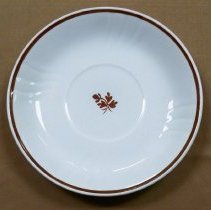
Ironstone china cup plate/saucer |
Description |
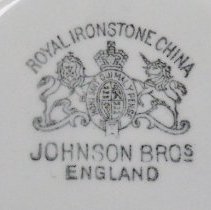
Ironstone china cup plate/saucer. Copper lustre glaze Tea Leaf pattern with three scallops on leaves; faint fluted border in four areas. Bottom stamp: Royal Ironstone China, Johnson Bros., England with a Royal Arms Mark (lion, crown, unicorn & motto of the Empire). Dated between 1891-1913. Part of a collection belonging to Annette & Ken Koehler, Hutchinson, MN. They originally found three pieces of Tea Leaf pattern dishware in their house at 43-6th Avenue SE where rural mail carrier Charles L. Robertson had lived. The Koehlers were given a piece by Roger & Verna Henke, and began to search antique stores to accumulate a collection as a hobby. Several pieces were donated to the museum. Tea Leaf ironstone dishes were named for their decorations. There was a superstition that it was lucky if a whole tea leaf unfolded at the bottom of your cup. This idea was translated into the pattern of dishes known as Tea Leaf. By 1850 at least twelve English factories were making this pattern, and by the 1870s it was a popular pattern in many countries. The Tea Leaf was always a luster glaze on early wares. There are many variations of Tea Leaf designs, such as Teaberry, Pepper Leaf, and Gold Leaf. The designs were used on many different white ironstone shapes, such as Bamboo, Lily of the Valley, Empress, and Cable. The Tea Leaf pattern was first called Lustre Band and Sprig. Other names: Band & Spray, Lustre Band & Spray, Edge Line and Sprig, Lustre Leaf, Lustre Spray. The design consists of three leaves with scalloped edges, usually five scallops. There is one bud on a long stem, curved sharply to the left, between the leaves. Two smaller stems flank the base of the design. Potters printed a brown design outline from an engraving plate on a dish, then fired on a glaze over it, then put the lustre over the glaze exactly over the design by hand. There is also usually a wide band of lustre around the rim of a dish and a narrower band around a base. The bands were applied by continuous turning of the item beneath a hand held brush. The piece was fired a second time at a much lower temperature in order not to burn off the copper lustre or distort the color. Johnson Bros. (Frederick, Robert & Lewis) began business in 1883 when they purchased the Charles Street Works of Hanley, Strattfordshire, England. Johnson Bros. were the last potters to begin making Tea Leaf - just before the turn of the century. Along with Meakin they were the "Henry Fords" of the dish world. At a modest price they turned out durable, lighter weight ironstone china. Johnson Bros. sold to Montgomery Ward with its advantageous mail order system as did other companies. Nineteenth century pioneers favored heavy practical dishware that would stand long moves by river boats, heavy wagons or trains. Dishes had to withstand countless washings using homemade lye soap. Most American housewives followed fashions set by their English sisters - from pewter to yellowware, to cream colored Queensware, to multicolored Staffordshire, and finally plain white ironstone. Tea Leaf caught the ladies' fancy because it was simple white, yet had elegant shapes, copper lustre added color, it was durable, and it was cheap. It is said Mary Todd Lincoln used Tea Leaf in the White House, but it was not the fancy china of lace-covered tables; instead it was used in the modest homes of farmers, miners, millers and country people across America. Undecorated white ironstone was first patented by Charles James Mason in England in 1813 and English potter Anthony Shaw created the original Tea Leaf motif in the 1850s. Due to its sturdiness and affordability Tea Leaf decorated ironstone was made into everything from tea cups to chamber pots. From 1875 to 1900 Tea Leaf was the most popular pattern made. By 1900 at least 25 English potters had produced their own variations of Tea Leaf and perhaps 12 American contempories tried to get a share of the market. English Tea Leaf was sent to the U.S. by the shipload. It was packed in barrels and distributed throughout the country by the cheapest method possible. Tea Leaf was used as ballast in ships landing along the Atlantic Coast. After discharging the dishware they loaded with cotton, wood, tobacco. Thus the Tea Leaf ballast made the trip more profitable than using & dumping rocks as ballast. After 25-30 years Tea Leaf went out of style and was not shown in catalogs after 1910. |
Catalog Number |
2015-0078-007 |
Search Terms |
Tea Leaf ironstone Royal Ironstone China, Johnson Bros., England Johnson Bros., Royal Ironstone China, England Saucers Tableware |
Subjects |
Tableware Saucers |