
Object Record
Images
Metadata
Object Name |
Cutter, Tobacco |
Caption |
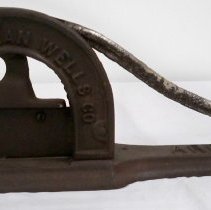
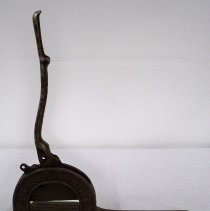
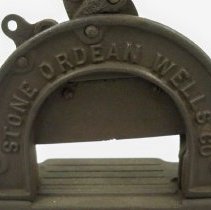
Tobacco plug cutter |
Description |
"Arrow" tobacco plug cutter marked Stone, Ordean, Wells Co. Used by a grocer or tobacco shop for measuring and cutting plug tobacco. Guillotine style; made of iron; for use on a countertop with mounting holes; base is marked in half inch increments up to two inches. William R. Stone founded what would become the Stone-Ordean-Wells Company—Duluth’s first wholesale grocer—in 1872. Albert Ordean soon jumped on board, but it wasn’t until 1896 that Benjamin Wells would join them to complete the firm’s name. Traphagen & Fitzpatrick designed their four-story Romanesque building of brick and Port Wing brownstone at 203–211 South Fifth Avenue West, Duluth MN. Built for $4,800, the building had a flat corner entrance and arched windows on the top floor. It could ship and receive items from railcars along tracks on one side of the facility and from ships via a dock along Minnesota slip on another. Stone-Ordean-Wells distributed mainly groceries with brand names of Nokomis, Hiawatha, Stone, Bluebird, and Express, but it also dealt with automobile tires, cigars, and wooden ware. They manufactured peanut butter and syrup, ground sugar, and at one point roasted and ground about 3.5 million pounds of coffee a year. The firm had three branch offices in North Dakota, four in Montana, and one in Minneapolis—which strictly handled tobacco products—and distributed in Michigan’s Upper Peninsula, Wisconsin, Minnesota, the Dakotas, Montana, Wyoming, and eastern Idaho. Plug tobacco was a type of solid brick chewing tobacco & was the way chewing tobacco used to be sold. When a whole "block' of pressed tobacco was produced, instead of cutting it into flakes or slices, the manufacturer would cut it into smaller "blocks" or "cubes". Plug tobacco was what tobacco lovers would buy before manufacturers put tobacco in little cans or pouches. The tobacco came in a big brick, and customers would buy a couple of inches at a time. To make the measuring and cutting easier, tobacco companies supplied the stores with plug tobacco cutters. These cutters were made of iron, and consisted of a rounded area that housed the blade, a lever that moved the blade, and a base with rule marks for cutting precise amounts. Since the tobacco company supplied the device free of charge, they might put a little bit of advertising on the plug cutter as well. Plug cutters were common from the 1800s through the 1940s, and came in many different styles and shapes There were also simple cleaver style tobacco cutters that were used at home and in tobacco shops and country stores to cut tobacco. These were not as precise but did the job. A plug cutter was a small tabletop machine that resembled a small paper cutter. |
Catalog Number |
1979-1526-001 |
Search Terms |
Tobacco cutters Stone, Ordean, Wells Company, Duluth MN |
Subjects |
Tobacco Tobacco shops Guillotines |